If your knees ache, your back slumps, or your legs fall asleep ten minutes into meditation, the problem probably isn’t you. It’s your seat.
Sitting on a hard floor with no support is one of the most common reasons beginners give up. A good meditation cushion lifts your hips, relaxes your legs, and lets your spine stay tall without effort. That small change can make the difference between dreading your practice and actually looking forward to it.
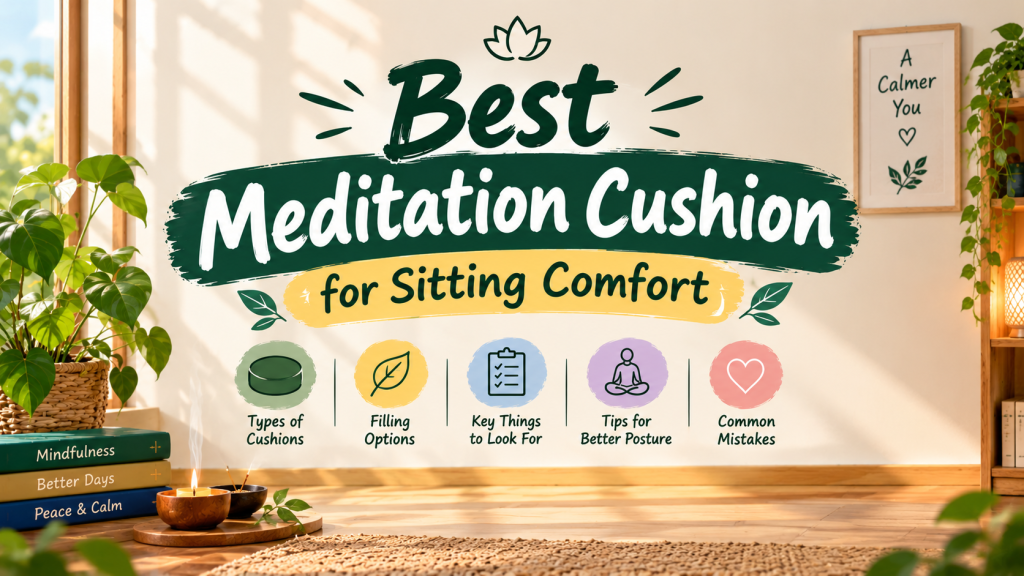
This guide explains how to find the best meditation cushion for sitting comfort, including the main types, the fillings, and the details that matter before you buy.
Why Your Seat Matters More Than You Think
When you sit flat on the floor with crossed legs, your hips often sit lower than your knees. That tilts your pelvis backward, rounds your lower back, and puts strain on your knees and hips.
A cushion raises your hips above your knees. This helps your pelvis tip slightly forward, which lets your spine stack naturally. You can stay upright without gripping your muscles, and that makes it much easier to relax and focus on your breath.
Types of Meditation Cushions
Not all cushions are the same. Here’s a quick comparison:
| Type | Best for | Things to know |
|---|---|---|
| Zafu (round cushion) | Cross-legged sitting | The classic choice, often pleated, usually raises your hips 4 to 6 inches |
| Zabuton (flat mat) | Cushioning knees and ankles | Goes under a zafu, great for longer sessions |
| Crescent cushion | Wider, stable seat | Curved shape supports the thighs, good for beginners |
| Rectangular bolster | Kneeling or sitting on the edge | Firm and flat, works well for Seiza-style kneeling |
| Support cushion (small) | Adding extra height | Useful for stacking or fine-tuning your height |
If you’re not sure, a zafu on top of a zabuton is the most popular combination. A crescent cushion is a good alternative if you find round ones tippy.
What’s Inside Matters: Cushion Fillings
The filling changes how your cushion feels and how long it lasts.
Buckwheat Hulls
Firm, supportive, and moldable. The hulls shift to match your shape and hold it, so they work well for people who want stable support. They can be a little heavy and make a soft rustling sound when you move.
Kapok
A soft, silky fiber from the kapok tree. It’s lighter than buckwheat and feels plush, but it can compress over time and needs occasional fluffing.
Cotton
A soft and affordable option. It’s comfortable at first, but tends to flatten faster, so it’s better for short sessions.
Foam
Light, consistent, and easy to wash around. Memory foam can feel supportive, though some foam cushions feel bouncy or too firm.
If you’re torn, buckwheat is the traditional favorite for stability, while kapok and foam are friendlier for people who want something softer or lighter.
7 Things to Look for Before You Buy
- Height. Most people sit comfortably on a cushion that’s 4 to 6 inches tall. Taller people or those with tight hips may need more.
- Adjustable filling. A cushion with a zipper lets you add or remove filling until it feels right.
- Firmness. Too soft and you’ll sink. Too firm and your legs can go numb.
- Size and width. A wider cushion gives more stability, especially if you tend to wobble.
- Removable, washable cover. You’ll use it often, so easy cleaning matters.
- Carry handle. Handy if you move it between rooms or take it to class.
- Non-slip base. A grippy bottom stops it sliding on smooth floors.
How to Choose Based on Your Body and Style
- Tight hips or knees: Choose a taller cushion or a crescent shape, and add a zabuton underneath.
- Back pain or a rounded back: Raise your seat a little higher so your hips tip forward.
- Kneeling position: A rectangular bolster or a cushion placed between your calves and thighs can reduce pressure on your ankles.
- Small frame: A lower or smaller cushion may feel more natural.
- Cannot sit on the floor at all: A chair is completely fine. Place a small cushion behind your lower back for support.
If you often feel sharp or lasting pain when you sit, check with a doctor or physiotherapist. A cushion can improve comfort, but it can’t fix an underlying issue.
How to Sit Properly on a Meditation Cushion
- Sit on the front half of the cushion. This lets your hips tip forward and your knees drop toward the floor.
- Cross your legs comfortably. Your knees should rest lower than your hips. If they float, add height.
- Stack your spine. Imagine a string gently lifting the top of your head.
- Relax your shoulders and jaw. Let your hands rest on your knees or lap.
- Soften your gaze. Close your eyes or look gently at the floor.
- Check in after a few minutes. If something feels strained, shift or adjust.
If you want to set the mood too, a calming scent can help. Here’s how to use incense for meditation safely.
Common Mistakes to Avoid
- Picking a cushion that’s too low. This is the most common mistake and the main cause of knee and back strain.
- Buying by looks alone. A pretty cushion is no use if it’s too soft or too small.
- Sitting in the middle of the cushion. Perching on the front half usually feels better.
- Staying in one position for too long. Shifting a little or changing positions is perfectly fine.
- Ignoring pain. Discomfort is a signal to adjust, not something to push through.
How to Care for Your Cushion
- Remove the cover and wash it according to the label.
- Fluff buckwheat or kapok fillings regularly so they don’t clump.
- Air it out in a dry, shaded spot every so often.
- Store it away from damp areas to avoid mold.
FAQs About Meditation Cushions
What is the best meditation cushion for beginners?
A zafu or crescent cushion with an adjustable filling is a good place to start, since you can tweak the height until it feels right.
How high should a meditation cushion be?
For most people, around 4 to 6 inches works well. The goal is for your knees to rest at or below hip level.
Is buckwheat or kapok better for meditation cushions?
Buckwheat is firmer and more stable. Kapok is softer and lighter. Choose the one that matches your comfort preference.
Do I need a zabuton too?
It isn’t essential, but it’s helpful if you sit on a hard floor, since it cushions your knees and ankles.
Can I use a regular pillow instead of a meditation cushion?
You can in a pinch, but pillows tend to be too soft and may collapse. A proper cushion gives steadier support.
Can I meditate in a chair instead?
Yes. What matters is a stable, upright, comfortable position, not sitting on the floor.
Final Thoughts
The best meditation cushion for sitting comfort is the one that keeps your hips lifted, your spine easy, and your mind free from wondering how long until you can move.
Start with the basics: the right height, a filling that suits you, and a cover you can wash. Try it for a few weeks, adjust as you go, and let comfort make your practice easier to stick with.